Jun 26, 2026 | Posted by Matt Elson
When most people think about the Toyota Production System, they think about manufacturing.
Assembly lines. Standardized work. Andon. Kanban. Flow. Automotive production.
That connection makes sense. TPS was developed in a manufacturing environment, and many of its most visible methods were shaped around the realities of automotive assembly.
But TPS is not only a factory system.
At its core, TPS is a way of thinking and managing. It applies anywhere work flows, customers are waiting, problems repeat, and leaders are responsible for developing people to improve the system.
That includes automotive dealerships.
Over the past several years, True North Thinking Inc. has had the opportunity to apply TPS thinking directly inside dealership environments, especially in fixed operations. That experience has reinforced a simple but important point:
Dealerships are not too different for TPS.
In many ways, they are exactly the kind of environment where TPS thinking is needed.

A service department may not look like a factory, but it is still a value stream.
A customer has a concern.
An appointment is scheduled.
The vehicle is written up.
Information is captured.
The work is diagnosed.
Parts are confirmed.
A technician is assigned.
The repair is completed.
Quality is confirmed.
The customer is updated.
The vehicle is delivered.
Each step affects the next.
When the system works well, customers experience more predictable service. Advisors are not constantly chasing information. Technicians are able to focus on value-added work. Parts teams can support the work before it becomes urgent. Leaders can see problems clearly enough to respond.
When the system does not work well, the symptoms are familiar:
Vehicles waiting.
Technicians interrupted.
Advisors expediting.
Parts not available when needed.
Carryover work.
Comebacks.
Unclear priorities.
Managers constantly jumping in to save the day.
These are not just people problems.
They are system problems.
TPS gives leaders a practical way to see that system, stabilize the work, and improve it.
Dealerships are full of activity.
Phones are ringing. Advisors are talking. Technicians are working. Parts are being ordered. Customers are being updated. Managers are making decisions.
But activity is not the same as flow.
A service department can be very busy and still have vehicles waiting, information missing, parts delayed, technicians interrupted, and customers dissatisfied.
One of the most valuable contributions of TPS is that it helps leaders distinguish between motion and value.
Where is the work stopped?
Where are people waiting?
Where is information missing?
Where are defects being passed forward?
Where are leaders compensating for weak process?
Where is the same problem happening again tomorrow?
Improvement starts when the current condition becomes visible.
That is why “go and see” is so important. Reports and meetings can tell leaders part of the story, but they cannot replace direct observation of the work.
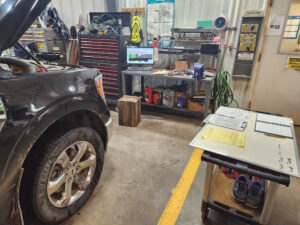
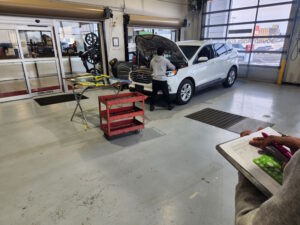
In a dealership, going to see means understanding the actual flow of work from the customer’s request through to final delivery. It means seeing the interruptions, delays, rework, handoff issues, communication gaps, and unclear standards that shape daily performance.
Many dealership improvement efforts focus heavily on technician productivity.
That matters. Technician productivity is important.
But TPS thinking forces a better question:
What conditions are being created before the technician starts the work?
If the repair order is unclear, if diagnosis is delayed, if parts are not available, if dispatching is unstable, if priorities keep changing, or if the technician is constantly interrupted, productivity has already been affected before the wrench turns.
The technician may be the person closest to the repair, but the system around the technician shapes the outcome.
This is why dealership improvement cannot only focus on individual performance. It has to look at the entire operating system.
How is demand understood?
How is work prepared?
How is information captured?
How are parts confirmed?
How is work assigned?
How are abnormalities surfaced?
How do leaders respond when the process does not work as expected?
These are TPS questions.
They are highly relevant in fixed operations.
Many organizations say they want continuous improvement, but they do not yet have enough standardization to improve from.
Without a clear standard, every problem becomes debatable.
Was the process followed?
Was there a process?
Was the issue caused by skill, workload, timing, information, parts, communication, or leadership response?
Without standardized work, leaders are often left managing opinions.
With standardized work, leaders can manage facts.
In dealership environments, standardized work does not need to be complicated. It can begin with simple, practical standards for appointment preparation, vehicle check-in, repair order quality, parts confirmation, technician dispatch, customer updates, carryover review, and quality confirmation.
The purpose is not to create bureaucracy.
The purpose is to create clarity.
A good standard helps people succeed. It makes the work visible. It makes problems easier to identify. It gives leaders something real to coach against. It creates a baseline for kaizen.
Standardized work is not the opposite of improvement.
Standardized work is the starting point for improvement.
Dealerships can introduce boards, checklists, dispatch rules, daily meetings, visual controls, and problem-solving forms.
Some of those tools may help.
But the tools are not the system.
The management system is what determines whether improvement sticks.
Leaders have to create the daily rhythm. They have to go and see. They have to confirm process. They have to ask better questions. They have to respond to abnormal conditions. They have to develop people instead of only correcting outcomes.
This is where TPS becomes much more than operational efficiency.
It becomes leadership development.
A strong management system creates a daily connection between business performance, process performance, and people development.
In a dealership, that may include daily review of yesterday’s performance, visibility of today’s demand, clear escalation points, leader confirmation of critical process steps, short problem-solving cycles, coaching around standards, and follow-up on repeated abnormalities.
This work is not glamorous.
But it is the work that makes improvement real.
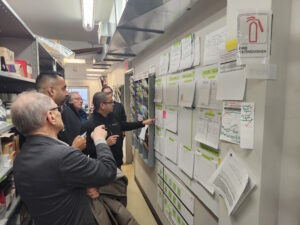
There is a difference between applying TPS and decorating the workplace with lean terminology.
Dealerships do not need more buzzwords.
They do not need generic lean posters.
They do not need complicated templates.
They do not need improvement theatre.
They need practical thinking applied to real work.
That means starting with the actual condition, not an idealized model. It means observing the work directly. It means respecting the people doing the work while also challenging the system they are working within.
It means building simple standards.
It means making problems visible.
It means developing leaders who can see abnormalities and coach improvement.
It means using kaizen to remove obstacles from the flow of work.
Most importantly, it means understanding that TPS is not a set of tools to install.
It is a way of managing.

Automotive dealerships are under pressure.
Customer expectations are rising. Technician availability is constrained. Vehicle technology is becoming more complex. Margins are being challenged. Leaders are expected to improve performance while also dealing with daily instability.
In that environment, traditional management often leads to more expediting, more pressure, and more dependence on a few strong individuals.
TPS offers a different path.
It helps dealerships build operating systems that are more stable, more visible, and more capable of improvement.
It helps leaders move from firefighting to problem solving.
It helps teams reduce daily frustration.
It helps organizations create better flow for customers, advisors, technicians, parts teams, and managers.
And perhaps most importantly, it helps leaders develop people through the work itself.
That is the real power of TPS in a dealership environment.
Not copying a factory.
Not forcing manufacturing tools into a service business.
But applying the principles of flow, standardized work, problem solving, kaizen, and people development to the real work of serving customers.
That is where meaningful improvement begins.


